

Start here
What is the SAT, and who needs it?
If your child wants to study abroad you will hear these three letters constantly. This page explains them once, properly, from the beginning.
Still have a question?
Leave your phone number — we will call back within 2 hours and answer it.
Apply nowFirst lesson free
What is the SAT?
The SAT is a standardised exam used in applications to US colleges and universities. It is written and administered by College Board, a US non-profit.
It has two sections — Reading and Writing, and Math — and measures knowledge built up over secondary school. It is not an IQ test, and it is not an English proficiency exam; that second point gets its own section below.
Total scores run from 400 to 1600.
The SAT is one part of an application. Universities also read school grades, essays, recommendations and activities. No score on its own secures admission.
How the exam is built
Since 2024 the SAT has been digital only, taken in College Board’s Bluebook app — at a test centre with a proctor, not at home.
- Reading and Writing — 64 minutes: two 32-minute modules, 54 questions.
- Math — 70 minutes: two 35-minute modules, 44 questions.
- A 10-minute break between the two sections.
- Total: 2 hours 14 minutes, 98 questions.
- The test adapts: how you do on a section’s first module decides whether its second is harder or easier. This happens at module level, not question by question.
- A calculator is allowed on both Math modules — the built-in Desmos or your own approved handheld. None during Reading and Writing.
2h14m is testing time only. With check-in and instructions, the morning at the centre is materially longer. Plan the day around that, not around the exam length.
Scores, and what they actually mean
Each section is scored 200–800. The two add up to a 400–1600 total.
“A good score” only means something relative to a group. College Board publishes two percentile scales. The first number compares you to all US 11th and 12th graders; the second, more realistic one compares you to students who actually sat the exam.
- 1200 — 81st / 75th percentile
- 1350 — 94th / 89th
- 1400 — 97th / 93rd
- 1500 — 99th / 97th
- 1550 — 99+ / 99th
Both scales are US-referenced, not global.
A 1400 does not mean “top 3% in the world.” College Board reports separate country percentiles, and that is a different number.
The digital SAT and the old paper one
The SAT most parents have heard of was a paper test lasting three hours. It went fully digital in 2024 and the paper version was retired.
What changed: about two hours instead of three; short passages with one question each instead of a few long texts; a calculator on the whole Math section; taken on a laptop or tablet; and it adapts to the student.
What did not change: still scored out of 1600, still taken at a centre with a proctor, still supported by free official practice.
The practical point: any book, video or tutor describing a three-hour paper test with a no-calculator math section is describing an exam that no longer exists.
Check the date on anything you buy.
The SAT is NOT an English exam
This is the most common misunderstanding here, and it is worth being blunt about.
IELTS and TOEFL measure English ability: listening, speaking, reading, writing.
The SAT measures secondary-school academic content — analysing texts and evidence, grammar and punctuation, algebra, geometry, trigonometry, data analysis. The questions are in English, but English is not what is being scored. The SAT has no speaking or listening component at all.
College Board draws the same line itself: most universities also require an English proficiency exam such as TOEFL or IELTS where a student’s first language is not English and their education was not in English.
The SAT does not replace IELTS or TOEFL. Most Uzbek applicants will need both.
Budget separate time and separate money for each.
SAT and ACT
The ACT is the alternative to the SAT. US universities accept both equally — Yale, Penn and Dartmouth all state in writing that they have no preference.
The main differences: scoring is 400–1600 on the SAT and 1–36 on the ACT. The ACT Composite covers English, math and reading; science and writing are optional and do not count toward it. The ACT’s core sections run 125 minutes. The SAT adapts to the student; the ACT does not.
There is no general answer to which is “easier” — it depends on the individual, and nobody can tell you in advance.
The reliable way to decide: sit one official practice test of each and compare. Free official practice exists for both. Then commit to one — splitting preparation between them is the most common mistake.
Do universities actually require it?
During the pandemic most universities made the SAT optional. Most selective ones have brought the requirement back — but not all, and not on the same timetable.
Every row below carries a link to that university’s own page. If we and they disagree, believe them, not us.
| University | For autumn 2027 entry |
|---|---|
| Princeton | OptionalStill optional for autumn 2027 entry. The requirement begins with autumn 2028. |
| Columbia | OptionalOptional for the 2026–27 cycle; required from the next one. |
| MIT | Required |
| Harvard | RequiredAllows equivalents in exceptional cases. |
| Yale | RequiredRemoved AP and IB as substitutes in May 2026 — much published advice is still out of date. |
| Dartmouth | RequiredAccepts three APs, IB or A-Levels from students schooled outside the US. |
| Brown | Required |
| Cornell | Required |
| University of Pennsylvania | RequiredOffers a hardship waiver. |
| Stanford | Required |
| Caltech | Required |
Last checked: 2026-08-05
“Everyone requires the SAT now” is false.
For students starting in autumn 2027 the SAT is still optional at Princeton, and optional at Columbia for this cycle.
When to start
College Board recommends sitting the SAT for the first time in the spring of 11th grade, then again in the autumn before deadlines. That advice is built around the US school calendar.
For a Fall 2027 start the testing window runs from autumn 2026 to spring 2027. Early-round applicants generally need to finish testing by October or December.
A 9th-grader does not need to sit the SAT now. At that stage the useful work is strengthening English, building solid mathematics, and reading widely.
How long preparation takes cannot be stated in advance, and we will not state it. It depends on starting level, target score and hours per week.
The honest first step is a free official practice test in Bluebook, to find out where a student actually stands. It is free, and it can be done today.
Cost, dates and materials
Test dates, registration deadlines, fees and ID rules live on their own page — we keep them in one place because they change.
Official preparation is free: full-length practice tests in Bluebook, the Official Digital SAT Prep course on Khan Academy, and the official question bank. It is free to everyone — you do not need to enrol with us to use it.
Still have a question?
Leave your phone number — we will call back within 2 hours and answer it.
Apply nowFirst lesson free
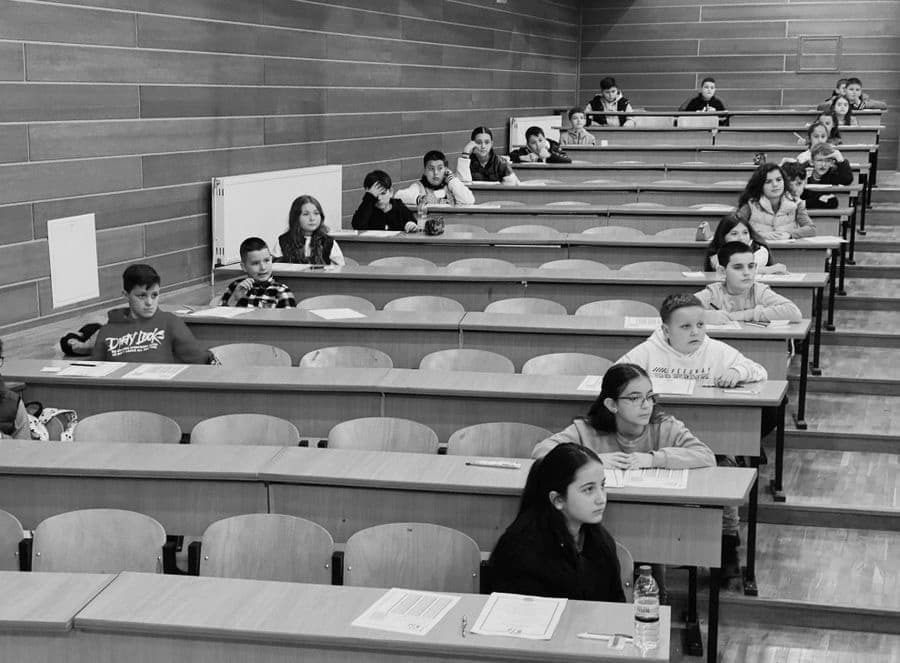
First step
Find out where you actually stand
Professional Diagnostics is not a course — it is a single sitting. You take a test under real exam conditions and get a written read-out by section: which topics are solid, which one is holding your score down. Only then is it clear which group you belong in.
- Free, online, and no obligation
- Under real exam conditions
- A report broken down by section and topic
- A teacher's commentary and a recommended programme
First lesson free
Application
Take the first step
Leave your details — we will get in touch, assess your level and tell you which programme fits.
- Phone
- +998 55 588 99 39
- Opening hours
- Monday – Saturday, 10:00 – 20:00
Leave your name and phone number