
Money
Scholarships and financial aid
How a foreign university decides whether your child pays everything or nothing. And why most of what you have been told about it is not true.
Still have a question?
Leave your phone number — we will call back within 2 hours and answer it.
Apply nowFirst lesson free
The hardest question first
We do not pay for anyone’s degree. We have no scholarship fund, no agreements with universities, and no ability to allocate money to a student.
What we can do is prepare someone for an exam. The money comes from the university, and this page explains how it decides.
We say it first because it is the most common lie in this business — “we will get you a scholarship.”
The two most expensive mistakes
Neither of these is academic. Both are paperwork, and both cost four years of aid.
Mistake one: thinking that not asking for money improves the chance of admission. Brown, Stanford, Cornell and Columbia each state the same rule in their own words — an international student must request aid at the moment of application. If they do not, they can never receive it. Even if the family’s circumstances change. For all four years.
Mistake two: reading “100% of demonstrated need is met” as “we will pay nothing.” Those are different things — see the next section.
Tick the financial aid box. Always.
That is the single most important sentence on this page.
What “meets 100% of need” does not mean
The phrase is not one product. Some universities close the gap with grants alone — nothing to repay. Others package a student loan and a campus job. Cornell says so on its own page: an international package may include grant aid, work-study and student loans.
And “full need met” is not “the price is zero.” A family contribution is calculated, and it can be substantial.
Always ask two separate questions:
How much is grant? And how much is loan and work?
Need-blind and need-aware
A need-blind university decides admission without looking at whether the family can pay. A need-aware university takes it into account.
Very few universities are need-blind for international students. We do not print how many — published counts contradict each other, and a wrong number helps nobody here. Read each university’s own financial aid page.
And the honest part: at a need-aware university, asking for a lot can itself lower the chance of admission. That is what makes the rule above hard — you must make the choice without knowing the outcome.
Our advice does not change: ask. There is no point being admitted without aid to a place you cannot attend without it.
How an SAT score turns into money
There are two mechanisms, and they get confused with each other.
In need-based aid the score affects admission only. The amount is decided by the family’s financial documents. Harvard states it plainly on its own site: all aid the university administers is based only on financial need. So at Harvard even a 1600 brings no scholarship — it improves the chance of getting in, and nothing else.
In merit scholarships the score sets the amount directly. That mechanism is real, but it lives at large public universities rather than the Ivy League. Alabama publishes its entire ladder:
University of Alabama — international freshmen, 3.50+ GPA
- 1200–1250$6,000 / a year
- 1260–1290$8,000 / a year
- 1300–1320$10,000 / a year
- 1330–1350$15,000 / a year
- 1360–1410$24,000 / a year
- 1420–1600$28,000 / a year
The top tier — Presidential Elite: 1600 with a 4.0 GPA. Its award is described in kind, as tuition plus housing, rather than as a figure.
Alabama’s own published costs, 2026–27
- Tuition and fees
- $36,724
- Direct costs
- $52,202
- Full cost of attendance
- $60,400
$24,202
Even the top $28,000 award leaves this much of the direct costs unfunded. The family pays that difference — every year, for four years.
Conditions that void the award entirely
- Scores must arrive officially from the testing agency. Self-reported scores do not qualify.
- No superscoring: a single sitting’s total must carry it, not your best sections across several.
- For Fall 2027 the application and official score must arrive by 4 December 2026. An SAT sat after that is too late for this money, whatever the score.
This is not a recommendation of Alabama. It is proof that the mechanism is real — and it lives at large public universities, not the Ivy League.
Last checked: 2026-08-05 · Source
CSS Profile and FAFSA
FAFSA is for US federal aid. An Uzbek citizen cannot use it. It is not your form.
Most selective universities ask international applicants for the CSS Profile instead. It is College Board’s form, it costs money, and it asks in detail about the family’s income and assets.
The CSS Profile site states that the Profile is free for families earning up to $100,000 a year. We could not confirm how that applies to a family in Uzbekistan — the page says nothing about applicants living abroad. So budget for the cost.
And ask each university separately: some issue their own waiver, some accept the free ISFAA form instead, and some let an applicant facing hardship submit the Profile after an admission decision.
The other costs of applying
The CSS Profile is one cost among several. Also budget for:
- Each university’s application fee.
- SAT registration and international fees — separately for every sitting.
- TOEFL or IELTS.
- Visa fees.
- All of them need an international payment card.
We have not assembled exact figures for all of these and will not invent them. Check each on the official site.
External programmes in Uzbekistan
El-Yurt Umidi. A state foundation that funds study abroad, including a bachelor’s quota. Competitions run more than once a year. Check the current terms and dates only at el-yurt.uz and eyuf.uz — we print no date here, because they change.
The condition that matters most: this is a contract, not a gift. A recipient commits to returning and working in Uzbek state organisations for a term set in that contract, and to repaying costs if it is broken. We print neither the term nor the sum — the figures circulating online rest on a superseded decree. Ask the foundation itself, before signing.
- FLEX is not a university scholarship. It is a one-year US secondary-school exchange for pupils in grades 9–10 and pays for no part of a US degree.
- Global UGRAD is a one-semester non-degree exchange, open only to students already enrolled at an Uzbek university — a school-leaver cannot apply.
- Fulbright requires a completed bachelor’s degree. A grade-11 pupil cannot apply.
- The Presidential state scholarship is a domestic award for students already at an Uzbek state university. It does not fund study abroad.
The real numbers
In 2024/25 there were 1,177,766 international students in the US, 357,231 of them undergraduates. By primary funding source: 51.5% personal and family money, 25.2% current employment, 19.3% a US college or university (IIE Open Doors 2025).
Do not misread the 25.2%. It covers all degree levels including graduate study and post-completion work authorisation. It does not mean a quarter of undergraduates work their way through. On a student visa, on-campus work is limited to roughly 20 hours a week.
No reliable figure exists for the share who receive full funding, and no reliable Uzbekistan-specific figure was found either. We will not derive one.
If anyone quotes you a percentage of their students who win full scholarships, that number was invented.
Ask us too. We do not have one either.
What we do not promise
We do not award, arrange or guarantee any scholarship. We cannot guarantee admission anywhere.
We do not promise a score gain either. Anyone promising a specific number cannot know it — not them, not us, not anybody.
What we can offer is the programme, the calibre of the teacher and the follow-up. The rest is your work.
Still have a question?
Leave your phone number — we will call back within 2 hours and answer it.
Apply nowFirst lesson free
First step
Find out where you actually stand
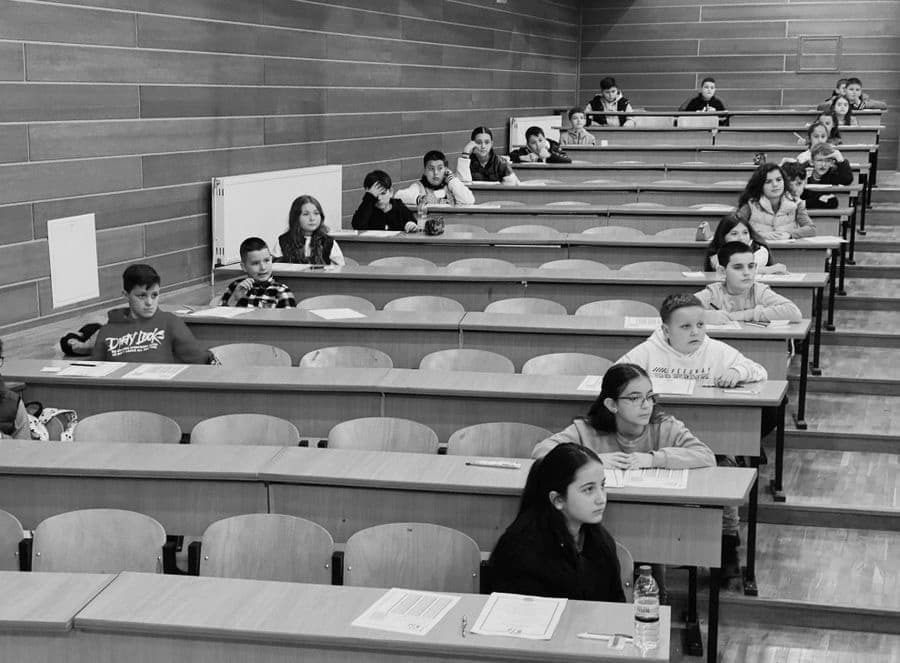
Professional Diagnostics is not a course — it is a single sitting. You take a test under real exam conditions and get a written read-out by section: which topics are solid, which one is holding your score down. Only then is it clear which group you belong in.
- Free, online, and no obligation
- Under real exam conditions
- A report broken down by section and topic
- A teacher's commentary and a recommended programme
First lesson free
Application
Take the first step
Leave your details — we will get in touch, assess your level and tell you which programme fits.
- Phone
- +998 55 588 99 39
- Opening hours
- Monday – Saturday, 10:00 – 20:00
Leave your name and phone number